
A Critical Essay
Abstraction is often asked to do two seemingly contradictory things: resist representation while remaining available to interpretation. It must hold the viewer’s attention without supplying a fixed narrative, create an encounter without prescribing its meaning. For Niki Woehler, this tension is not incidental to the work. It is embedded in the material character of her practice, where painting becomes an investigation of surface, depth, light and the physical conditions of looking.
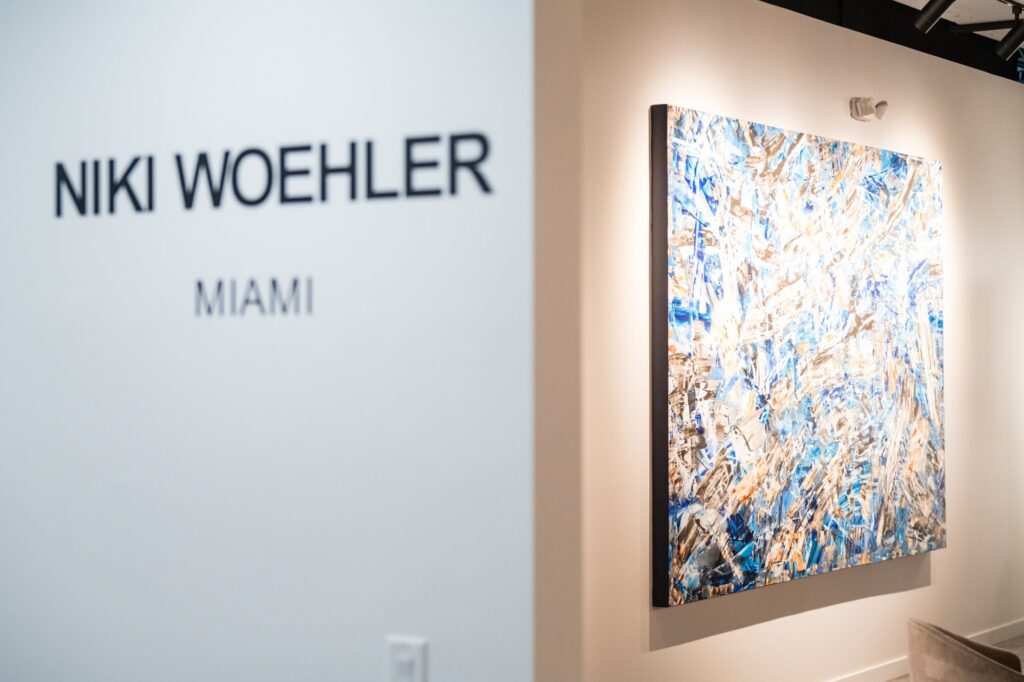
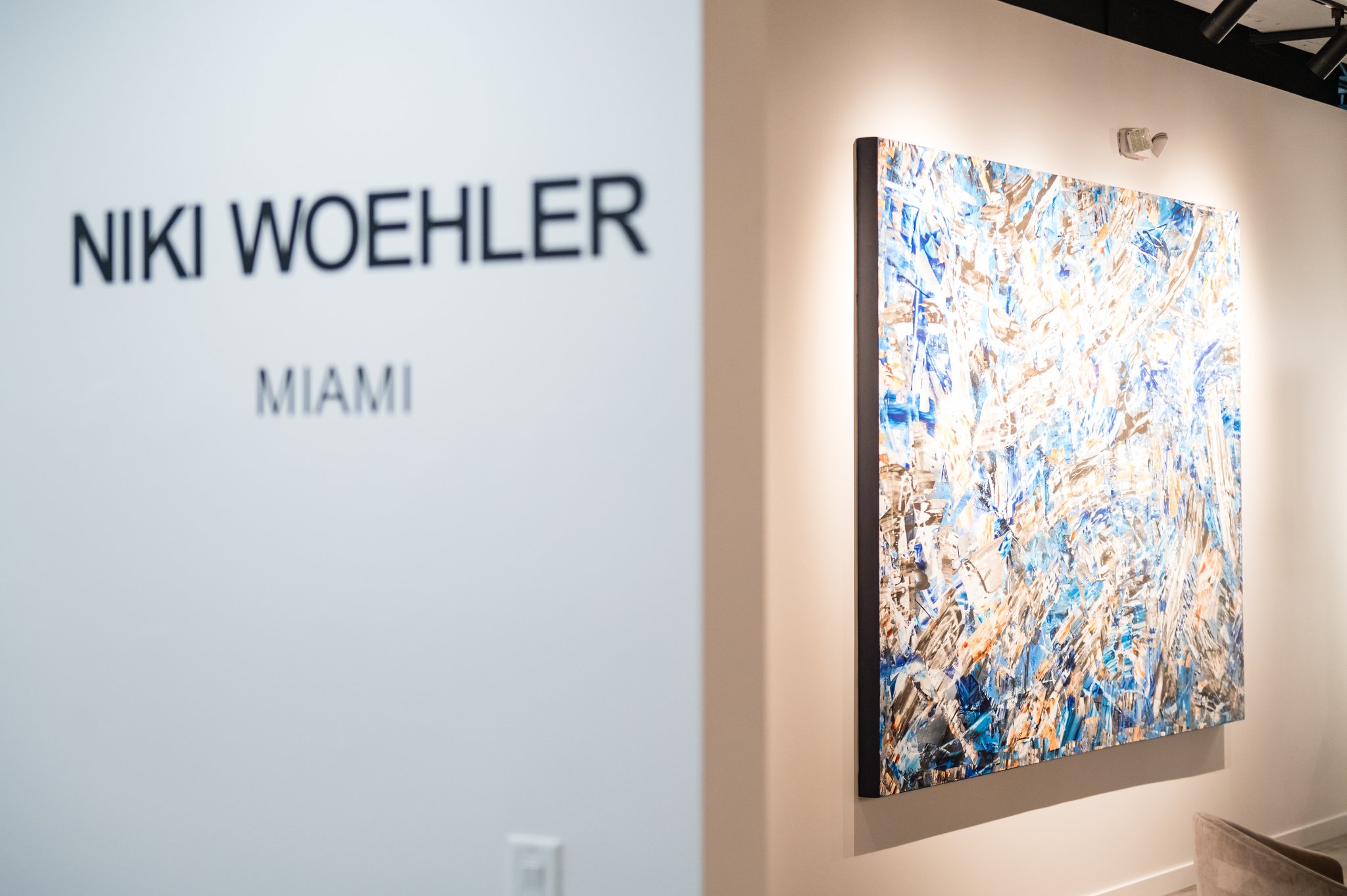
Woehler’s work occupies a productive threshold between painting and object. Her canvases, resin works and multi-panel compositions are not simply images contained by a support. They are constructed surfaces whose appearance changes according to distance, illumination and the viewer’s position. Texture interrupts the expected continuity of the painted plane; reflective finishes complicate the distinction between what is depicted and what is physically present. The surface becomes less a boundary than an active site of perception.
This is where Woehler’s practice merits closer attention. Its visual appeal is immediate, but its more interesting possibility lies in what happens after that first impression—when the eye begins to register the material decisions that make the image difficult to apprehend all at once.
Material as an Event
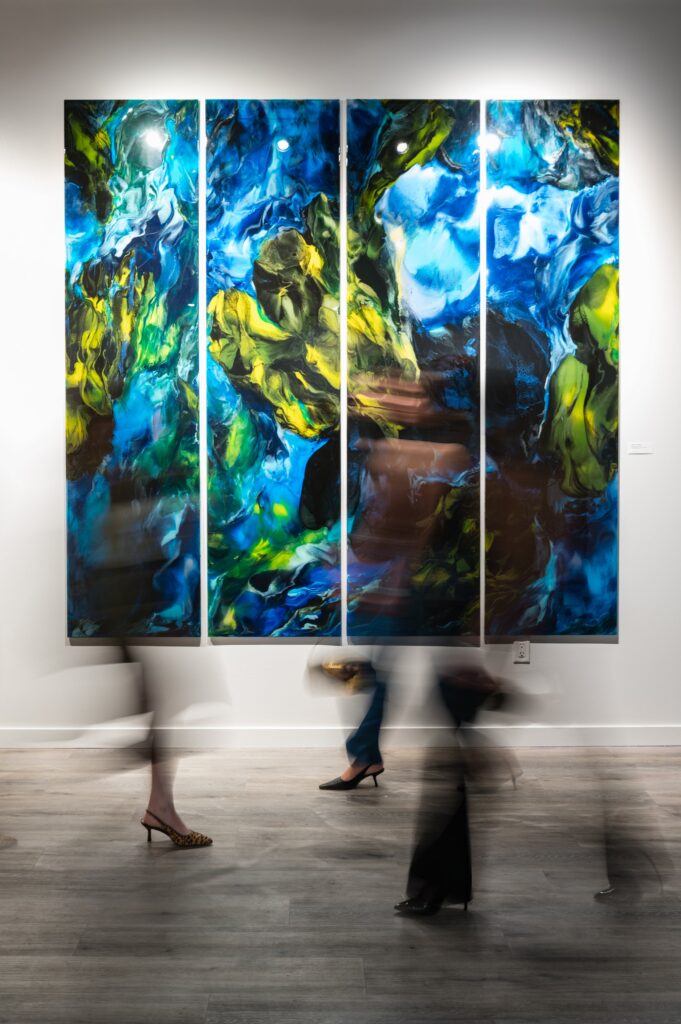
Niki Woehler works across acrylic, pigment, enamel and resin, among other materials. These substances do not function merely as a palette of effects. Each introduces a different relationship to time and visibility. Pigment can establish an expressive mark; enamel can sharpen or intensify a passage; resin can deepen the image while introducing a reflective, almost object-like presence. The resulting works hold together qualities that are not always easily reconciled: fluidity and control, opacity and luminosity, gesture and finish.
The distinction matters because abstraction can become overly dependent on the language of spontaneity. A work may appear instinctive while remaining highly resolved; conversely, a polished surface can conceal the complexity of its making. Woehler’s material combinations invite a viewer to consider both conditions at once. The work is not simply the trace of an expressive act, nor is it reducible to a perfected finish. It is the record of decisions made through material.
Her interest in surfaces shaped by natural forces—weathering, erosion, the gradual alteration of matter—offers another point of entry. Rather than treating imperfection as a motif to be reproduced, Niki Woehler draws on the visual logic of transformation: surfaces become compelling because they appear to have undergone something. The work suggests duration. It asks the viewer to read change not as damage or disorder, but as a source of visual complexity.
This approach places her within a long and varied history of abstraction concerned with the physicality of paint and the autonomy of the object. Yet the significance of that lineage is not a claim to novelty. Resin, texture and monumental scale are not new territories in contemporary art. The question is how an artist makes these elements cohere into a sustained visual language—and whether that language can hold attention beyond its initial impact.
Scale, Space and the Viewer
Scale is central to Woehler’s practice, but size alone does not determine the experience of a work. A large painting can dominate a room without changing how one sees; a smaller object can create a more intimate and demanding encounter. Woehler’s expansive works are most compelling when their dimensions become a condition of looking rather than a demonstration of magnitude.
At larger scales, the viewer cannot easily take in the work as a single image. Vision moves across it, registering changes in density, texture and movement. The body becomes involved: one steps back to apprehend the whole, then approaches to examine the surface. The work unfolds through this shifting distance. It is not only seen; it is negotiated spatially.
This relationship becomes especially important in Woehler’s commissioned practice. A work created for a residence, commercial environment or architectural setting enters into a dialogue with conditions that already exist: light, proportion, circulation, material and use. Such work occupies a complex position within contemporary art. It can expand the possibilities of painting by bringing it into direct relation with lived space. It can also risk being absorbed into the language of interior design, where visual harmony may take precedence over the work’s capacity to unsettle or resist.
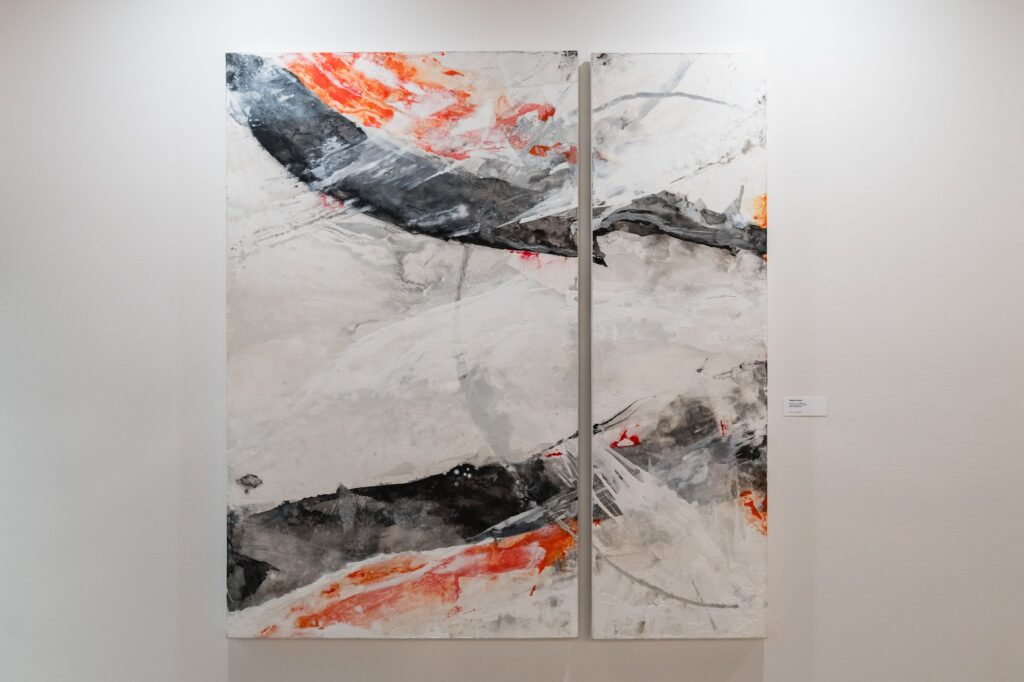
That tension should not be dismissed. It is one of the defining questions of Woehler’s practice. Her strongest work must do more than complement its surroundings; it must establish an independent presence within them. The artwork’s relationship to architecture becomes meaningful when it changes the experience of the space rather than merely completing it.
The distinction between decoration and art is not determined by whether a work is beautiful, commissioned or placed in a private interior. It rests in the depth of the encounter the work makes possible. Woehler’s material approach gives her a means of pursuing that depth, but the challenge remains active with every new work and installation.
Miami as Context, Not Conclusion
Woehler’s move to Miami introduces a new context for a practice developed over decades. The city’s visual environment—its intense light, architectural contrasts and overlapping relationships between art, design and international culture—offers conditions that may sharpen the concerns already present in her work. But a geographic transition does not, in itself, constitute artistic reinvention.
The more consequential question is what a new context allows an artist to reconsider. For Niki Woehler, Miami may provide an opportunity to test the relationship between surface and light, between monumental work and intimate viewing, between a studio practice and the public life surrounding it. The city becomes a setting in which existing questions can be extended, not a ready-made explanation for the work.
The establishment of The Atelier and The Salon makes this distinction tangible. The Atelier is dedicated to the concentration and labor of production; The Salon creates a separate setting for the presentation of work and encounters with visitors. Their separation acknowledges that making art and experiencing art require different conditions. One depends on sustained attention and the freedom to work; the other depends on access, exchange and the possibility of looking together.
The Salon’s cultural potential will ultimately be measured not by the number of gatherings it hosts, but by the quality and continuity of the conversations it supports. A space becomes meaningful within an art ecosystem when it contributes to more than visibility—when it creates room for artists, viewers and ideas to meet in ways that extend beyond a single occasion.
Beyond the Finished Surface
Woehler’s practice is situated in a contemporary landscape where painting is continually reconsidered through its relationship to objecthood, architecture, collecting and the spaces in which art circulates. Her work does not need to reject those conditions to be taken seriously within them. Instead, it must remain attentive to the tension between an artwork’s visual appeal and its capacity to sustain thought.
The most promising aspect of Woehler’s material language is its refusal to make surface a final answer. A reflective finish may attract the eye, but it can also delay certainty. Texture can suggest an image while resisting a definitive reading. Scale can command a room while requiring the viewer to move, pause and reconsider. These are not simply aesthetic effects; they are ways of organizing attention.
Woehler’s Miami chapter is therefore best understood as an unfolding proposition rather than a completed narrative of arrival. The studio and gallery provide a framework, but the work itself must continue to establish the terms of its relevance. Its contribution will emerge through the decisions made within the practice: how materials are handled, how scale is used, how commissions preserve artistic independence, and how the work continues to complicate the act of looking.
The surface is where Woehler begins. It is not where the encounter has to end.