
How Director Amara Karim Is Redefining Portraiture Through Film
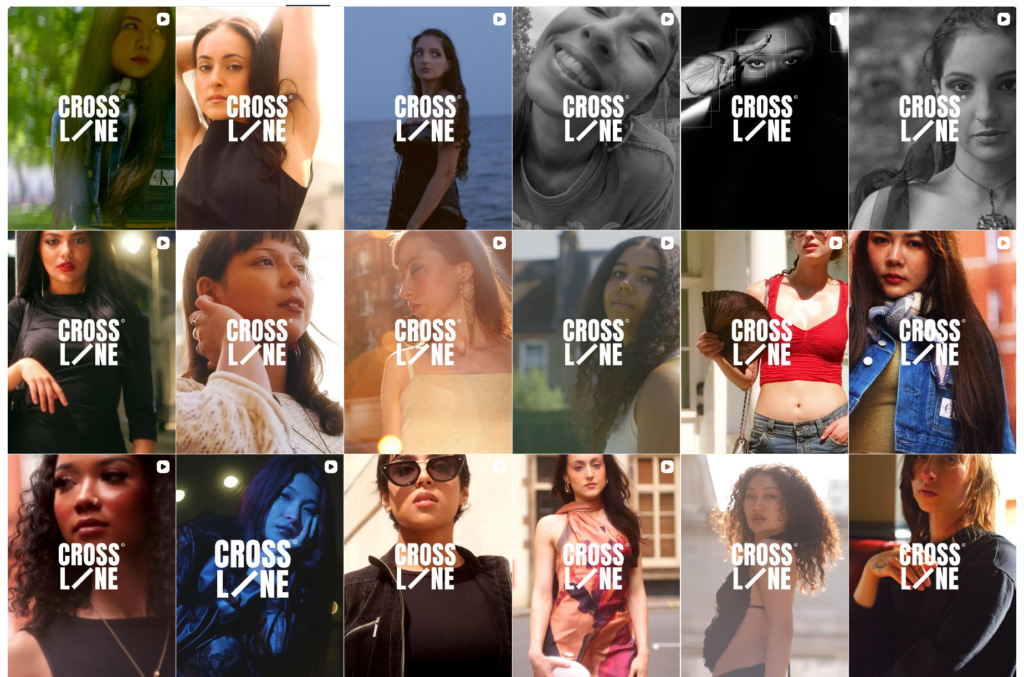
The filmmaker behind CROSSLINE Editorial Film Portraits is quietly reshaping the way portraiture is experienced. Portraiture has traditionally been associated with still photography. For London director and cinematographer Amara Karim, however, a portrait is something far more immersive. Through his creative platform CROSSLINE, Karim is pioneering an approach he describes as Editorial Film Portraits—a fusion of fashion, cinema and human expression. Built around the belief that movement reveals personality just as much as appearance, CROSSLINE creates cinematic short films that capture atmosphere, emotion and identity through carefully crafted visual storytelling. Every frame is intentionally designed, allowing each subject to become part of a narrative rather than simply the focus of a photograph. Karim’s filmmaking journey spans more than ten years, during which he has directed commercial productions, music videos and creative projects across multiple disciplines. That experience has shaped a distinctive visual language defined by elegant camera movement, understated storytelling and a refined editorial aesthetic. “The camera isn’t there simply to record someone,” explains Karim. “It’s there to reveal something about them. The moments between poses are often the most interesting because that’s where authenticity lives.” Inspired by the worlds of fashion editorials, independent cinema and contemporary culture, CROSSLINE embraces collaboration as a core part of its philosophy. Models, creators, artists and brands are invited to contribute to projects that prioritise artistic expression over commercial convention, resulting in films that feel both intimate and cinematic. Editorial Film Portraits by Amara Karim Are the New “It” Form of Portraiture Since its launch, CROSSLINE Editorial Film Portraits has steadily attracted a growing network of collaborators who share Karim’s passion for creating meaningful visual work. Rather than chasing trends, the platform has become recognised for its distinctive editorial style, cinematic compositions and carefully considered approach to storytelling. As CROSSLINE continues to evolve, Karim is preparing the next chapter of the project through new collaborations with models, creators, artists and fashion brands across the UK and overseas. With Volume Two currently in development, the platform continues to build an expanding body of editorial work while exploring new creative ideas and partnerships. While independently driven, Karim’s long-term vision is simple: to continue building CROSSLINE Editorial Film Portraits into a recognized creative platform where cinema, portraiture and fashion intersect—creating work that feels timeless regardless of changing trends. About CROSSLINE Founded by director and cinematographer Amara Karim, CROSSLINE is a London-based creative platform dedicated to Editorial Film Portraits. Combining cinematic filmmaking, fashion influences and visual storytelling, the project creates moving portraits designed to feel timeless rather than trend-driven. Follow the journey as CROSSLINE continues to collaborate with models, artists, creators and fashion brands across the UK and internationally. CROSSLINE Instagram: @crosslinestudio.co Amara Karim Instagram: @amarakarimfilm Website: www.crosslinestudio.co YouTube: https://www.youtube.com/@CROSSLINESTUDIOEditorialFilmPo Explore: https://linktr.ee/crosslinestudio
Reframing Memory: The Interdisciplinary Practice of Iranian Contemporary Artist Aidin Bagheri
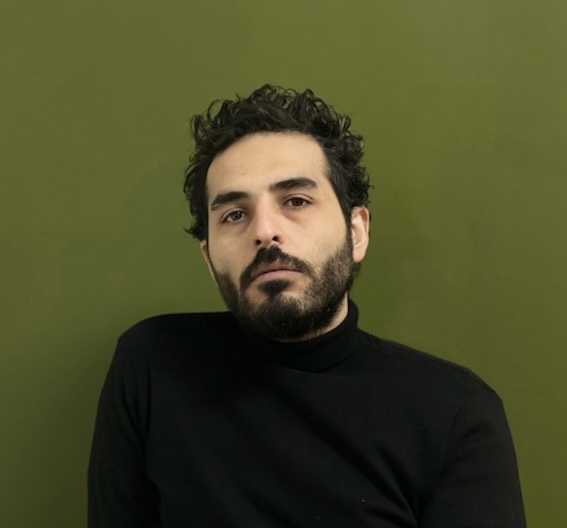
What happens when photography becomes more than a record of reality and begins to function as a form of historical inquiry? For Iranian contemporary artist Aidin Bagheri, images are not passive documents but active participants in the construction of memory, identity, and collective understanding. Working across photography, documentary cinema, installation, and academic research, Bagheri has developed a practice that challenges conventional distinctions between art and investigation, aesthetics and evidence. Based between Tehran and Paris, Bagheri belongs to a generation of artists whose work moves fluidly across disciplines while remaining deeply rooted in lived experience. Trained in sociology, he approaches image-making as a process of observation and engagement, often developing projects through extended periods of fieldwork. Rather than offering definitive conclusions, his work creates space for questions about how societies remember, how histories are constructed, and whose experiences become visible within the public record. Over the past ten years, Bagheri’s work has been featured in numerous solo and group exhibitions, steadily building his presence within both Iranian and international contemporary art contexts. Through these presentations, he has developed a body of work that bridges documentary observation and critical inquiry, engaging audiences with questions of history, identity, labor, and collective memory. The sustained visibility of his practice across diverse exhibition platforms reflects a commitment to long-term research and visual storytelling, positioning him among a generation of artists expanding the possibilities of documentary-based contemporary art. Further underscoring his professional engagement with the Iranian art community, Aidin Bagheri is an official member of the Association of Photographers of Iran and the Association of Sculptors of Iran, affiliations that reflect the interdisciplinary nature of his artistic practice and its dialogue with both photographic and spatial forms. This concern is particularly evident in Zendeh Baad Karkhaneh, a photographic series that examines the lives and working conditions of laborers in Iranian factories. Developed through close observation and sustained engagement with industrial environments, the project moves beyond conventional representations of labor to reveal the human experiences embedded within spaces of production. Bagheri’s photographs capture moments of routine, endurance, and solidarity, drawing attention to the physical and emotional realities that often remain invisible behind systems of manufacturing and economic output. A similarly nuanced approach characterizes Garden of Dolls, a project centered on a remarkable environment created from discarded dolls and recycled objects in the Iranian desert. What could easily be framed as an eccentric curiosity is instead approached with sensitivity and attentiveness. Bagheri’s photographs reveal a space shaped by imagination and resilience, where abandoned materials acquire unexpected significance. The resulting images blur the boundaries between documentary observation and visual metaphor, inviting viewers to reconsider the ways meaning is constructed through acts of creation and preservation. While photography remains central to his practice, Aidin Bagheri has increasingly expanded his exploration of social realities through documentary filmmaking. His recent documentary, Kiln House (2025), focuses on the lives of Afghan workers in Iran, a community whose experiences often remain underrepresented within dominant media narratives. Rather than relying on distant observation, the film foregrounds everyday realities, offering an intimate portrayal of labor, displacement, and dignity. Through careful attention to lived experience, Bagheri presents migration not as an abstract political issue but as a deeply human condition. What distinguishes Bagheri’s work within contemporary visual culture is the close relationship between artistic production and research. His images do not merely illustrate ideas; they participate in the generation of knowledge. This perspective informs his ongoing doctoral research at the École des Hautes Études en Sciences Sociales (EHESS) in Paris, where he investigates the role of citizen photography in contemporary Iran. At a time when billions of images circulate across digital networks, Bagheri’s research asks a fundamental question: who gets to create history? His work examines how photographs produced by ordinary individuals can function as alternative archives, preserving experiences and perspectives that frequently remain absent from institutional records. In an era increasingly defined by contested histories, digital archives, and competing versions of truth, Aidin Bagheri’s work feels especially relevant. By bringing together documentary observation, visual storytelling, and critical research, he demonstrates how contemporary art can serve as a space where memory is questioned, histories are reconsidered, and new forms of understanding become possible.
Capturing Creativity On The Streets Of Venice Beach And London
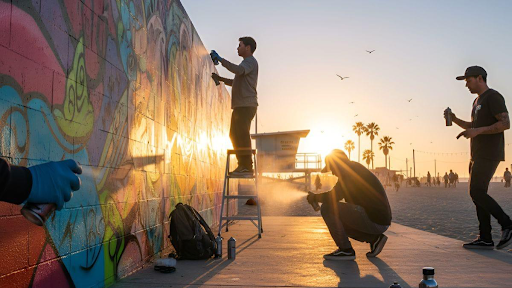
A Reflective Essay by Paige Evans Street art has always fascinated me because it exists completely outside of traditional spaces. It’s public, temporary, unpredictable, and usually created by people who are driven more by expression than recognition. Over the last year, I’ve found myself increasingly drawn to photographing street artists, particularly during a trip to Venice Beach and later back in London. There’s something very raw about the creative energy in Venice Beach. Along the boardwalk, you’re constantly surrounded by painters, musicians, skaters, performers, and muralists all creating in real time. The history of street art there feels deeply connected to the identity of Los Angeles itself, shaped by artists like Jean-Michel Basquiat and Keith Haring, whose work helped blur the line between street culture and contemporary art. Even now, you can feel that influence in the way creativity exists so openly within public space. What interested me most wasn’t necessarily the artwork itself, but the people behind it. A lot of the artists I photographed were creating simply because they had to create. Some were selling pieces to get by, others were painting for hours without anyone stopping to watch. Photographing them became more about documenting presence and process than producing polished portraits. Coming back to London, I noticed similarities within areas like Shoreditch, where street art also exists as part of the environment and culture. But there’s a different energy between the two cities. Venice Beach felt open and performative, whereas London often feels more closed off and observational. Across both places, photographing street artists taught me to slow down and pay attention more carefully. The work became less about chasing perfect images and more about documenting people existing within their creative world naturally. Author Bio Paige Evans is the founder of PANNA DESIGNS, a studio working across web design, photography, and videography, with a focus on visual storytelling and content-led digital experiences.
