
What to Expect in the Commercial and Residential Real Estate Market in 2026 – D. Sidney Potter

D. Sidney Potter Explains What to Expect The general consensus amongst many market makers in 2026 is a carbon copy of 2025, but slightly more tempered. Nothing wrong with a more somber and palliated forecast, given the heretical nature of 2025, which saw many unforeseeable events. Even jaded fellows such as myself were impressed. To name a few surprises in 2025 – that likely won’t make a reappearance in 2026, include the following: Given the excessive near hypnotic hoopla over Artificial Intelligence, the acceleration of this tech science was unprecedented this past year and was particularly vulnerable to cyber threats. Other outliers included a late surge in buyer activity in Fall 2025 (no one saw that coming, despite high interest rates), the increasing cost of homeowner overhead as a result of climate change (think insurance rates), and the rise of geopolitical events affecting buyer behavior. Real Estate Outlook in Commercial Here’s a bullet list of top highlights to expect in year 2026 of the year of our good Lord over the next 12 months – God willing. And in the light of divine positivity, commercial is discussed first given the sedate nature of residential in 2026, as notated above. Here goes for commercial: Market Outlook in Residential Fortunately, and to lighten the mode a bit, it’s not as if residential real estate is expected to go to Hell in a Handbasket, per se. As a disclaimer, not certain why the religious overtone for this year’s predictions, since real estate is a fairly agnostic science. Could be because the time of year – since forecasts are written during a religious themed month that includes the likes of Christmas, Kwanzaa and Hanukkah. But here goes, and in the interest of brevity, more bullet points: Summary Despite a tranquil and placid forecast for residential in 2026, there will be more movement in some areas; given sales are expected to rise, interest rates are expected to lower, and the pricing on residential product will slow down. Commercial on the other hand is a whole different ball of wax, where one can expect a whole lotta hollering from the back pews as buyers will raise prices and more trades will be at record highs. Until then, rest easy and say a pray to the real estate Gods, in that there are more winners then losers over the next year. Amen. Author Bio Real estate writer D. Sidney Potter is based in Southern California. He has a PhD (ABD) from the University of Arizona, a law degree (Juris Master) from Florida State University College of Law and a bachelor’s degree (BA) from Cal Poly Pomona in political science.
Yinka Shonibare and Peter Doig Paintings: Two Forces Reshaping Contemporary Art
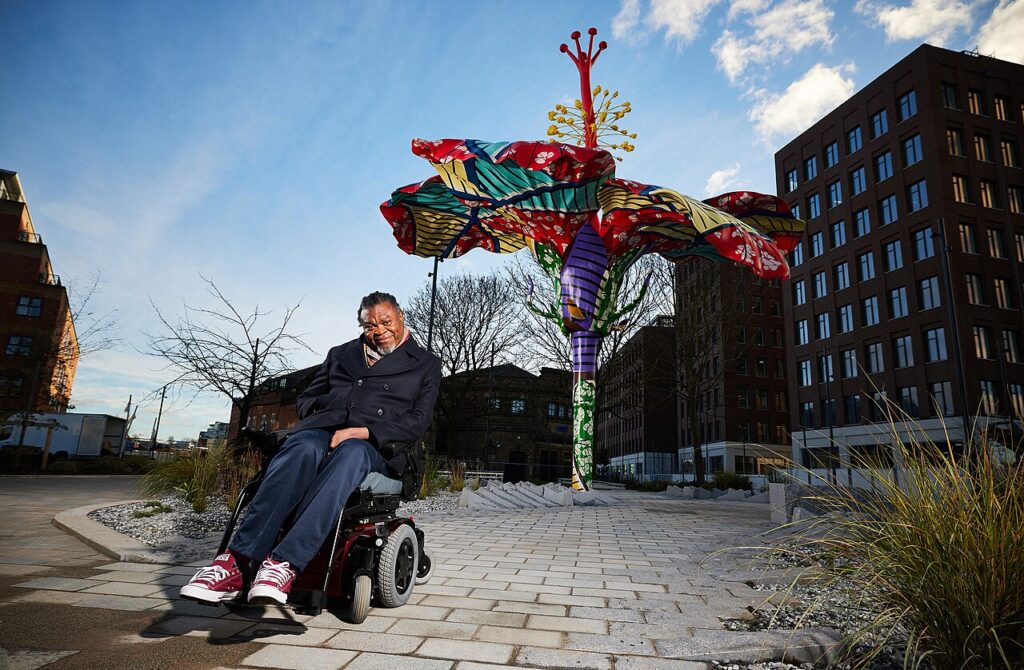
The contemporary art world is experiencing a remarkable surge of interest in works that challenge, provoke, and delight. Peter Doig paintings have emerged as some of the most sought-after pieces in today’s global art market, commanding serious attention from collectors and institutions alike. Alongside this excitement, Yinka Shonibare continues to stand as one of the most significant and thought-provoking voices in contemporary art. Together, these two names represent the vitality and diversity driving the art scene forward. What Makes Peter Doig Paintings Unique in Today’s Art Market Peter Doig paintings occupy a rare space where figuration, memory, and atmosphere converge. Doig builds layered, dreamlike compositions that feel simultaneously familiar and deeply strange. His canvases draw on personal memory, cinema, and vernacular imagery, producing works that resist easy categorization. This resistance to trend is precisely what has made Peter Doig paintings so enduring. Where much contemporary painting chases conceptual or minimal directions, Doig commits fully to the painted surface — to color, texture, and narrative suggestion. At auction, Peter Doig paintings consistently achieve extraordinary results. His work White Canoe sold for over $11 million, and demand shows no signs of slowing. Collectors recognize that these paintings combine aesthetic power with long-term investment value — a combination that is increasingly rare in today’s saturated market. Institutions across Europe and North America have also acquired Peter Doig paintings for permanent collections, further cementing his position as a defining figure of his generation. Yinka Shonibare: Style, Humor, and Artistic Identity Yinka Shonibare CBE is a British-Nigerian artist born in London and raised in Lagos, whose practice spans sculpture, installation, photography, and film. He is best known for works that incorporate Dutch wax fabric — the brightly patterned textile associated with African identity, though rooted in complex colonial trade histories. This layering of cultural identity and historical irony is central to everything Yinka Shonibare creates. His work is visually arresting, conceptually sharp, and laced with a dry, knowing humor that invites viewers to question assumptions about race, empire, and belonging. What sets Yinka Shonibare apart from many of his contemporaries is the deliberate use of joy and spectacle as vehicles for serious critique. His headless mannequins dressed in vibrant fabric recreate aristocratic scenes with a twist — the colonial power structures underpinning those scenes become impossible to ignore. This approach has earned Yinka Shonibare widespread institutional recognition, with major works held by Tate Modern, the Smithsonian, and the Museum of Modern Art. Connecting Yinka Shonibare to Peter Doig Paintings: Shared Themes in a Modern Context On the surface, Yinka Shonibare and Peter Doig paintings seem to operate in different registers — one sculpts and installs, the other paints atmospheric canvases. Yet both artists share a fundamental commitment to storytelling through visual complexity. Peter Doig paintings embed cultural references — Caribbean landscapes, hockey players, film stills — within painterly surfaces that reward sustained looking. Yinka Shonibare similarly constructs scenes laden with historical and cultural reference, demanding that viewers do interpretive work. As contemporary collecting expands, ceramics and tactile art forms are increasingly discussed alongside painting and installation. The conceptual energy that Yinka Shonibare brings to fabric and three-dimensional form echoes the materiality collectors appreciate in Peter Doig paintings. Both practices insist on the physical presence of the artwork — that something irreplaceable happens when a viewer stands before the actual object. This shared insistence on material experience explains why both Yinka Shonibare and Peter Doig paintings attract collectors who value depth over decoration. Why Collectors, Galleries, and Online Platforms Are Investing in Peter Doig Paintings Galleries from London to New York actively seek Peter Doig paintings for group and solo exhibitions. The works carry critical credibility alongside commercial appeal — a combination that makes them highly versatile for both public programming and private acquisition. Online platforms including Artsy and Sotheby’s digital sales have introduced Peter Doig paintings to a new generation of collectors who discovered contemporary art through digital channels and are now willing to invest significantly. Beyond the market, Peter Doig paintings are understood as documents of a particular moment in painterly thinking — a time when representation returned to prominence without abandoning conceptual ambition. That cultural significance only deepens with time. Yinka Shonibare and Peter Doig Paintings Define the Contemporary Moment The contemporary art world is richer for the presence of both Yinka Shonibare and Peter Doig paintings. Doig’s luminous, memory-saturated canvases and Shonibare’s fabric-draped critiques of empire arrive from different directions but share a common ambition: to make images that matter. For collectors, galleries, and anyone paying attention to where art is headed, Yinka Shonibare and Peter Doig paintings are not simply trending names — they are essential reference points for understanding creativity, identity, and value in the twenty-first century. Photo Credit: Yinka Shonibare CBE RA in front of the Hibiscus Rising sculpture by David Lindsay.
Ahlam Expands Beyond Fashion with Sculptural Collaboration by Jonas Macek
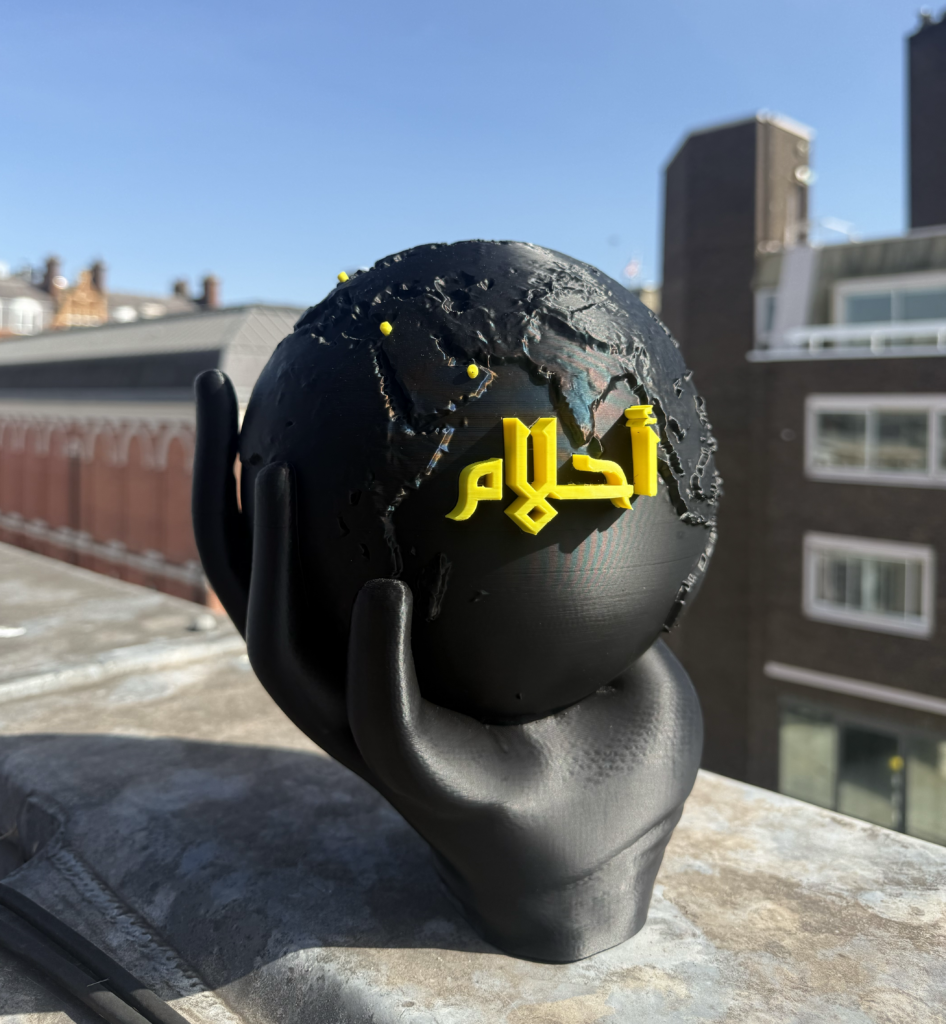
Ahlam, the Saudi Palestinian fashion label whose name translates to “dream” in Arabic, continues to expand its creative language beyond clothing through a recent sculptural collaboration. Originally launched in the UAE and now establishing a presence in London, the brand has built a distinct identity rooted in contemporary interpretations of Middle Eastern culture. Its growing visibility, including features from Mille World and Hypebeast Arabia, places Ahlam among a new wave of designers shaping regional narratives on an international stage. As part of this evolution, the brand collaborated with London based designer Jonas Macek to develop a contemporary art piece that explores identity, geography, and the material expression of language. The result is a 3D printed sculpture depicting a hand holding a globe, a form that reflects both support and expansion. Across the surface, subtle markers indicate locations tied to the brand’s cultural footprint, including the UAE, Palestine, and the United Kingdom. Embedded within the structure is the word “Ahlam” in Arabic, not applied as a surface detail but integrated directly into the form. This approach transforms the script into something spatial and physical, shifting it from graphic to object. The piece sits outside of traditional fashion formats, functioning instead as a sculptural extension of the brand’s identity. By moving into three dimensional form, Ahlam continues to explore how its narrative can exist beyond garments. Developed through digital fabrication, the work takes advantage of 3D printing to achieve fluid geometries and complex surfaces, allowing for a more experimental yet precise translation of concept into form. Speaking on the collaboration, Macek notes: “Rather than treating the identity as something applied onto an object, the idea was to embed it directly into the structure. It becomes part of the form itself, not just something you see, but something that holds the piece together.” The collaboration forms part of an ongoing creative relationship between Ahlam and Macek, with further sculptural works and cross disciplinary projects currently in development. Together, they are exploring how fashion identity can extend into objects, environments, and physical experiences. As Ahlam continues to grow across regions, this expanding body of work signals a broader direction for the brand, one that moves fluidly between fashion, art, and design, building a more immersive and spatial expression of its identity. References
